Chama Management System Kenya 2026 — Complete Guide for Chamas & Investment Clubs
A complete guide to chama management systems in Kenya. Learn how chamas, investment clubs and welfare groups use automated software to track contributions, manage shares, split dividends and collect M-Pesa payments in 2026.
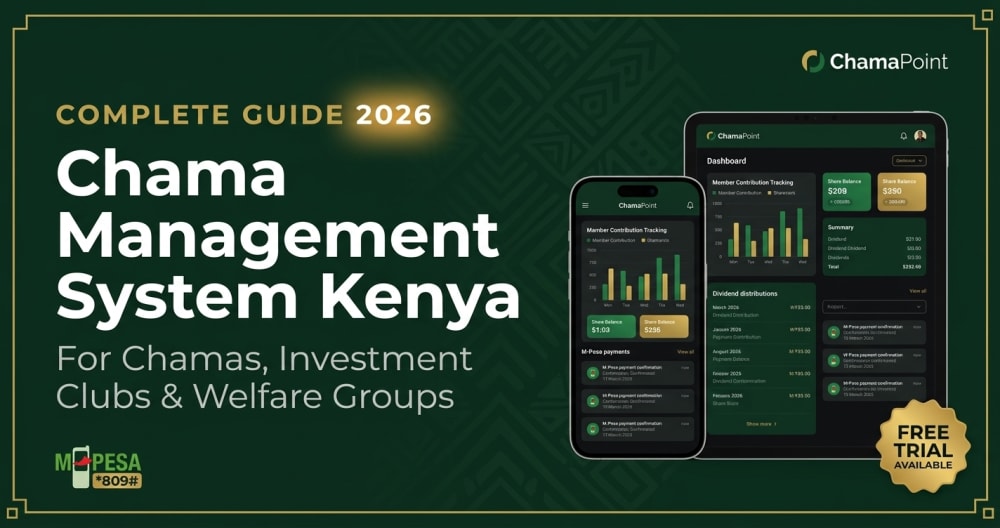
What Is a Chama Management System in Kenya?
A chama management system in Kenya is software that automates the day-to-day financial operations of a chama, investment club, or welfare group. Instead of relying on handwritten notebooks, WhatsApp messages, and Excel spreadsheets, a chama management system handles everything digitally — recording contributions, managing share balances, calculating dividends, processing M-Pesa payments, giving members self-service access to their own accounts, and generating reports that every official and member can trust.
Kenya has one of the most vibrant informal savings cultures in the world. There are an estimated 300,000 active chamas across the country, managing a combined portfolio of over KES 300 billion in pooled savings and investments. Yet the vast majority of these groups are still running their financial operations on tools that were never designed for the job. A treasurer managing a chama with 50 members on WhatsApp and Excel is not just working too hard — they are creating serious risks around transparency, accuracy, and trust.
A chama management system in Kenya solves all of this. It creates a single source of truth that every member can access, every official can manage, and every auditor can verify — without anyone having to trust a single spreadsheet or WhatsApp screenshot.
Why Kenyan Chamas Struggle Without a Proper Management System
The problems that come with running a chama manually are well known to any treasurer who has tried it. Understanding these problems is the first step to understanding why a chama management system is not a luxury — it is a necessity for any serious group.
Contribution disputes are the most common cause of chama breakdowns in Kenya. When contributions are recorded manually, errors creep in. A member pays via M-Pesa but the treasurer is busy and forgets to update the spreadsheet. Another member pays in cash and the amount is recorded wrong. By the time the AGM arrives, three members are disputing their balances and nobody can agree on the numbers because the records are inconsistent.
Dividend calculation errors destroy trust faster than almost anything else. When a chama declares its annual dividend, the treasurer must calculate each member's share based on their exact contribution and share balance across the entire year. Done manually, this calculation is prone to errors — and even a small error in a member's dividend payout is enough to cause a major dispute and damage the group's cohesion.
Lack of member transparency is the root cause of most chama conflicts. When members have no way to independently verify their own contribution balance, share count, or dividend history, they have no choice but to trust the treasurer completely. This is not fair to the member or the treasurer. Transparency is the foundation of trust in any financial group — and transparency requires a system, not a person.
Single point of failure is a risk that every manually-run chama carries. If the treasurer's phone is lost, stolen, or damaged, the entire financial history of the group can disappear overnight. If the treasurer leaves the group under difficult circumstances, the handover of records becomes a major exercise. A chama management system stores everything securely in the cloud — accessible to any authorized official from any device, at any time.
How a Chama Management System Works in Kenya
A chama management system automates the entire financial lifecycle of a chama from the moment a new member joins to the day a dividend is declared.
When a new member joins, the system creates their member profile, records their joining date, and sets their initial share balance to zero. As they make their first contribution via M-Pesa, the payment is received through the system's Paybill or till number, reconciled automatically in real time, and credited to their contribution balance and share account simultaneously — with no manual entry required by the treasurer.
Each month, the system tracks which members have paid their contributions and which have not. Automated SMS reminders go out to members before the contribution due date. After the due date, the system flags members who have not paid and notifies the relevant official. Late payment penalties are calculated and applied automatically according to the group's rules — no manual calculation, no uncomfortable conversations.
When a member wants to check their balance, they do not need to call the treasurer. They log into their member portal on the web or mobile app, or dial the group's USSD code on any phone, and see their full financial picture — current contribution balance, total shares held, loan balance if applicable, and full transaction history going back to the day they joined.
When the chama is ready to declare its annual dividend, the treasurer opens the dividend module, enters the total amount to be distributed, and the system calculates every member's payout automatically based on their exact share balance. The treasurer reviews the calculation, approves it, and the system disburses each member's dividend directly to their M-Pesa account — or records it as a credit to their account if the group reinvests dividends.
Every transaction, every approval, every change in the system is logged permanently in the audit trail. If any member ever questions any figure, the treasurer can pull the exact history in seconds and show them every entry — date, amount, and who recorded it.
Key Features Every Chama Management System in Kenya Must Have
Not all chama management software is built for how Kenyan chamas actually operate. Here are the features that matter most when choosing a platform.
M-Pesa Native Payments is the most important feature for any Kenyan chama management system. Members must be able to pay their contributions directly via M-Pesa and have the payment reflected instantly on the system without any manual reconciliation by the treasurer. This single feature eliminates the most time-consuming part of running a chama.
Automatic Share Management tracks each member's share balance in real time and updates it automatically with every contribution. The system must handle members who join at different times, buy additional shares, or miss contributions — and reflect all of these changes accurately in each member's share balance.
Automatic Dividend Calculation takes the total dividend amount declared by the group and distributes it among members pro-rata based on their exact share balance — down to the last shilling. This eliminates the single most common cause of AGM disputes in Kenyan investment clubs.
USSD Member Self-Service allows every member to check their own balance, view their contribution history, and confirm their dividend by dialing a USSD code on any phone. This is critical in Kenya where many chama members — especially in rural areas — do not have smartphones or consistent internet access.
Loan Management for groups that give internal loans to members. The system must handle loan applications, approvals, disbursement via M-Pesa, repayment tracking, and penalty calculations — all automatically, with a full audit trail.
Full Audit Trail logs every transaction permanently. Every contribution, every dividend, every loan disbursement, every approval — all recorded with a timestamp and user ID so that nothing can ever be disputed without a clear paper trail.
Real-Time Dashboard gives chama officials a live view of the group's total contributions, outstanding balances, share distribution, dividend history, and loan portfolio — all in one place, accessible from any device at any time.
Types of Groups That Use Chama Management Systems in Kenya
A chama management system in Kenya serves several different types of savings and investment groups, each with slightly different requirements.
Investment clubs that pool funds to purchase shares, property, or other assets need detailed share tracking, dividend calculation, and investment performance reporting. The system must handle varying share prices across different contribution periods and calculate pro-rata payouts accurately at dividend time.
Welfare groups that collect contributions for emergencies, funerals, school fees, and other events need contribution tracking, member balance management, and fast disbursement to members in need — ideally via M-Pesa within minutes of approval.
Merry-go-round chamas that rotate the full contribution pot among members each cycle need a system that tracks whose turn it is, records each payout, and ensures every member receives their fair share before the cycle repeats.
Chamas with internal lending that offer loans to members from the group's pooled funds need a full loan management module including application workflows, multi-level approvals, M-Pesa disbursement, repayment tracking, and NPL management.
Why ChamaPoint Is Kenya's Best Chama Management System
ChamaPoint was built specifically for Kenyan chamas by a team that understands exactly how Kenyan savings groups operate. Every feature was designed around real chama workflows — not adapted from a generic accounting platform.
M-Pesa is the core payment channel, not a plugin. USSD is a first-class member access channel via *809#, not an afterthought. Dividend calculation is automatic and auditable, not a manual spreadsheet exercise. Share management updates in real time with every contribution, not at month end. And every transaction is logged permanently in an audit trail that any member can request to see.
ChamaPoint works for groups of 10 members and groups of 500 members. It handles simple merry-go-round chamas and complex multi-asset investment clubs. It gives treasurers the tools to run their group professionally and gives members the transparency they deserve.
One plan. Every feature. KES 2,500 per month with a 7-day free trial and no credit card required.